FILE - In this March 15, 2010, file photo, copies of the 2010 Census forms are seen during a news conference in Phoenix to kickoff a national drive as Census forms are mailed to everyone. To keep pace with rapidly changing notions of race, the Census Bureau wants to make broad changes to its surveys that would treat "Hispanic" as a distinct category regardless of race, end use of the term "Negro" and offer new ways to identify Middle Easterners. The recommendations released Wednesday, Aug. 8, 2012, stem from new government research on the best ways to count the nation's demographic groups. (AP Photo/Ross D. Franklin, File)
FILE - In this March 15, 2010, file photo, copies of the 2010 Census forms are seen during a news conference in Phoenix to kickoff a national drive as Census forms are mailed to everyone. To keep pace with rapidly changing notions of race, the Census Bureau wants to make broad changes to its surveys that would treat "Hispanic" as a distinct category regardless of race, end use of the term "Negro" and offer new ways to identify Middle Easterners. The recommendations released Wednesday, Aug. 8, 2012, stem from new government research on the best ways to count the nation's demographic groups. (AP Photo/Ross D. Franklin, File)
WASHINGTON (AP) ? To keep pace with rapidly changing notions of race, the Census Bureau wants to make broad changes to its surveys that would treat "Hispanic" as a distinct category regardless of race, end use of the term "Negro" and offer new ways to identify Middle Easterners.
The recommendations released Wednesday stem from new government research on the best ways to count the nation's demographic groups. Still it could face stiff resistance from some racial and ethnic groups who worry that any kind of wording change in the high-stakes government count could yield a lower tally for them.
"This is a hot-button issue," said Angelo Falcon, president of the National Institute for Latino Policy in New York City and a community adviser to the census. "The burden will be on the Census Bureau to come up with evidence that wording changes will not undermine the Latino numbers."
Arab-Americans said they strongly support the Census Bureau's efforts. "The Census Bureau's current method for determining Arab ancestry yields a significant undercount of the actual size of the community, and we're optimistic that the new form should be significantly better at capturing ancestry data," the Arab American Institute said in a statement.
The research is based on an experiment conducted during the 2010 census in which nearly 500,000 households were given forms with the race and ethnicity questions worded differently. The findings show that many people who filled out the traditional form did not feel they fit within the five government-defined categories of race: white, black, Asian, Pacific Islander and American Indian/Alaska Native; when questions were altered to address this concern, response rates and accuracy improved notably.
For instance, because Hispanic is currently defined as an ethnicity and not a race, some 18 million Latinos ? or roughly 37 percent ? used the "some other race" category on their census forms to establish a Hispanic racial identity. Under one proposed change to the census forms, a new question would simply ask a person's race or origin, allowing them to check a single box next to choices including black, white, or Hispanic.
The other changes would drop use of "Negro," leaving a choice of "black" or African-American, as well as add write-in categories that would allow Middle Easterners and Arabs to specifically identify themselves.
Census director Robert Groves, who leaves his position Friday to become provost at Georgetown University, described the research findings as an important first step toward making changes in future censuses.
"As new immigrant groups came to this country decade after decade, how we measure ethnicity changed to reflect the changing composition of the country," Groves said. "Since that change is never ending and America gets more and more diverse, how we understand and tabulate the information has to be continually open to change."
"It's critical that race and ethnicity reflect how people identify themselves," he said.
The issue isn't just semantic. Some African-Americans in 2010, for instance, criticized a question asking if a person was "black, African- American or Negro," saying the government's continued use of the term "Negro" was demeaning and offensive.
"We believe the proposed changes are consistent with the way most people do choose to self-identify and will enable census to more accurately capture the growing racial/ethnic diversity in the U.S.," the National Urban League said Wednesday in a statement.
The wording in census surveys can also be highly political: census data are used to distribute more than $400 billion in federal aid and draw political districts and thus can elicit concern if a change were to yield a lower response.
While individual Hispanics have expressed dissatisfaction with census forms that don't count Latino as a race, Latino political groups have been reticent about pushing for a change. The main reason: Past research has sometimes shown that treating Latinos as a mutually exclusive group on survey forms leads to a lower Hispanic count.
"Why would Latinos want to give up their own question on the census form that specifically asks if they are of Hispanic, Latino or Spanish origin?" asks Falcon of the National Institute for Latino Policy. He notes that the current wording, which first asks people if they are of Latino origin and then prompts them to fill in their race, fostered a strong count in 2010 that yielded a new census milestone for Latinos of 50 million, or 1 in 6 Americans.
Nicholas Jones, chief of the racial statistics branch at the Census Bureau, said the government's more recent research found that Latino response rates were similar under both the current and the new proposed format. Across all race and ethnic groups, the nonresponse rates dropped notably to 1 percent under the proposed change, compared with nonresponse rates of roughly 4 to 5 percent with the traditional form.
Jones said the research identified ways to improve responses that will be used to discuss any survey changes with members of the Latino, black, Asian and other communities leading up to the 2020 census.
The government definitions of race groups are set by the White House Office of Management and Budget. Currently, Hispanics are an ethnic group, which means although they share a common language, culture and heritage, they do not share a common race. They can be black, white, Asian, American Indian or descended from original peoples of a place colonized by Spain.
Changes to questions on census forms also must be approved by Congress.
Other research findings:
?Removing the term "Negro" from the census form did not hurt the response rates of African-Americans. While some people in 2000 indicated that the term still had relevance to them, this number has steadily declined since then.
?Under the proposed changes, the number of people who reported multiple races increased significantly. The multiracial population is currently one of the nation's fastest growing demographic groups.
?When provided write-in lines, as much as 50 percent of people who checked their race as "white" wrote in an ethnicity such as Italian, Polish, Arab, Iranian or Middle Eastern. More than 76 percent of black respondents also wrote in an ethnicity, such as Jamaican, Haitian or Ethiopian.
?Based on focus groups, many people supported creating a separate racial category for those who identify as Middle Eastern or North African.
Many demographers predict a wider range of responses on census forms and blurring of racial categories over the next 50 years as the minority population grows and interracial marriage becomes more common. In the case of Hispanics, the nation's largest minority group, the label as an ethnicity to date has created particular confusion.
For instance, the Census Bureau describes Asian-Americans as the nation's fastest-growing race group from 2000 to 2010; their rate of growth is actually equal to that of Hispanics, an ethnic group. On the other hand, Hispanics are typically treated as a race for purposes of counting "interracial" marriages in the U.S.
Terry Minnis, director of census and voting programs at the Asian American Justice Center, said more tests are needed to ensure that Asian-Americans are fully counted under a new question format. Recent tests by the Census Bureau show some decreases in responses when there were fewer check boxes available for the various Asian-American groups, which include among others Asian Indian, Chinese, Japanese, Filipino and Vietnamese.
"As the Census Bureau looks to develop new strategies that maximize measurement and reporting on race and ethnicity, it must ensure that nothing compromises the quality and detail of data on Asian Americans," Minnis said.
___
Online:
www.census.gov
Associated Pressshawn johnson Tony Sly Lauren Perdue tagged weather radar Heptathlon London 2012 shot put


 regarding how to prep, paint & display figures. You?re invited? to attend! Bring your enthusiasm, figures and painting supplies and we?ll figure? out the rest later! The free lessons take place at the Source every 3rd Sunday? of the month starting at 1:30PM.
 al Spaghetti Social on Saturday, September? 22, 2012 from 6PM to 6PM at the Moose Lodge located at 5927 Concord Boulevard in? Invergrove Heights, MN? 55076 . It?s fund raising event ($12.00 per person)? for one of the longest running clubs of its type in America and we hope you can? join for a good old fashioned time!? Furthermore ?We have been active in? Minneapolis/St. Paul, Minnesota, science fiction community for more than 20? years. For us, Star Trek is a starting point to launch friendships. We take our? common interest in the show and optimism in our future and apply it to the world? around us. Whether it?s attending our regular meetings, participating in a? community service project, or socializing at one of our parties or campouts, the? Nokomis can be as much as you want to make it.? Take it from us?last year this? event was a ton of fun and a great opportunity to support a great club and have? a good time! We hope to see you there!
 u want be the aliens trying to conquer Earth. Army vs Aliens tests your? gaming skills in fast-paced dice combat. By combining strategy, cunning and a? little luck, players outsmart their opponents to win. Eighteen custom dice-9 for? each team-deliver full-value fun. The handy guide helps players plan their? battle moves. The game also features two dice cups that snap together to double? as a carrying case for portability and play anywhere fun!Available right now at? the Source along with thousands of other great games!
  Night at the Source for every 2nd Saturday of each month. The idea is simple, bring up any board game you want to play starting at 7PM. All types of board games, players, skill levels, ages (children under 18 must be with a parent) and interests are welcome! The start time for each GamePalooza is 6PM. After 9PM, you?re welcome to bring any food items for yourself or to share with the group (beverages are restricted to those purchased at the Source). Our first couple of Game Nights have been reallly fun and well attended! Keep in mind it?s a first come, first served event. Something for everyone and everyone welcome! For more info call Patrick at the Source 651.645.0386
 September 28, 29 & 30th, 2012. Mark your calendars! Last year we made Friday our? paranormal night and added our 1st Film Festival competition and had great? success. We will be bringing back those events and adding more! Check back often? for new guests and new developments. For More Information about this really fun event: www.crypticonminneapolis.com


 by Jon Lamkin a group has? taken the initiative to start up our very own homegrown version of the Pathfinder Society. This, of course, features RPG cenarios, player rewards (TBA) and good old fashioned fun based on the red hot Pathfinder RPG by Paizo Publishing. All that is required is your very own copy of the core book and your boundless enthusiasm! All players and skill levels are welcome! For more info harass Jon at jonflamkin@gmail.com
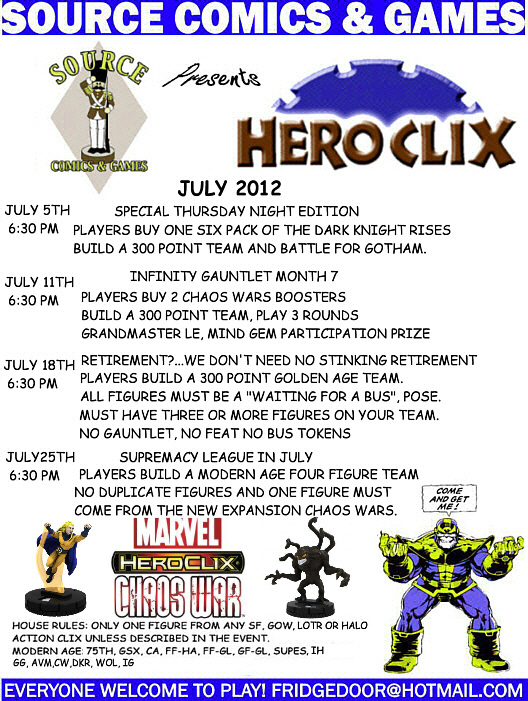 For more information: fridgedoor@hotmail.com
 a group of dedicated military miniatures game players assemble for a night of comradery, revelry and table top miniature fun! Themes change week to week and they?re open to game suggestions as well. Bring your stuff if you have any, if you don?t, show up anyway and we?ll get you in the game. All players and skill levels are welcome! Here?s the general schedule for the next upcoming few weeks.For More Info: fitzg037@umn.edu
 uman (or more than? human) intelligence, prodigious musical talent
 Greetings from Tim?s corner! Lots of stuff has been put out recently. From our? inventory titles? from Program through Punisher were restocked. From? collections, Atari Force, Beware (Marvel horror), Brave & the Bold vol1 pre 100? issues, Conan the Barbarian in the early 100?s, issues of G.I. Combat, Sherlock? Holmes issues from various companies, Silver Surfer vol2, Soloman Kane (Marvel),? Space Above & Beyond, Spectre vol3 issues, Superman vol2 pre 100, SuperTeam? Family issues, Terminator various issues, and Thor vol2 some of the earlier? issue, all went out. Lots more to put out, so keep checking in. Tim